
When Rejection Becomes You
I was ghosted after an interview, the first rejection in my life time. Instead of feeling rejected, I chose to give it a thought. I gave it a piece of my mind.

Hey thinkers!
Hanif here.
In normal circumstances, rejection isn't something we'd encounter on a daily basis. Yes, the probability of being rejected is almost non-existent. That is, not until we've grown up and had no choice other than to take part in job hunting.
Though it may share the same word, the gravity of job hunting has mostly been alleviated so that it affects our survival to a lesser extent. Unlike food hunting as it was eons ago.
However, no matter how evolved our technology might have been, the history of humanity, that which we're currently creating at a constant pace, only constitutes a third of our history as a species. The present world we perceive and take for granted is relatively new. But we're not new. We're not subject to invention.
The very core reasoning behind job hunting and food hunting remains one and the same: to make ends meet—a survival codex immune to the continuous forward flow of time. As a species, we could safely claim to have successfully conquered the earth and the nature it sustains. So why is it we still hunt jobs as if we're hunting foods? Rejection.
I know, that answer might not seem straightforward to you now but please bear with me.
Eons ago, the conflict which generates the plot of the human story is the strife between mankind vs. nature: man vs. harsh climates, man vs. hordes of bison, man vs. school of fishes, man vs. plagues, and the list goes on.
Here's an interesting fact. At the bottom of that list is man vs. man. You should've known it intuitively.
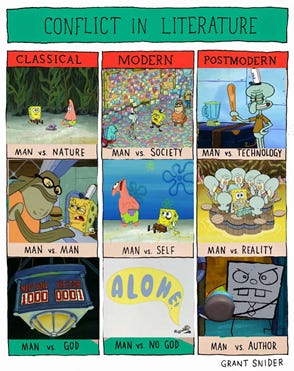
The man vs. man story is rich. Our collective history of wars and struggles for domination is what makes it worth telling. But again, the shift in the trend has already taken place. Let's face it, it is obsolete to see wars as our story. It's now time to reflect and go a bit inward. The "man vs. himself" curtain has been raised: man vs. proclivity for violence, man vs. evil desires, man vs. corruption, man vs. depression, and in this case, man vs. rejection.
With this narrative in mind, the above question is best answered with rejection. Come, please try to think about the fear of rejection for a moment. Do you find the semblance it shares with the fear instilled by lions, storms, and wars?
Alright, let's first agree upon the fact that fear has been serving us the purpose of keeping our physical selves intact for millennia. (Again, from a survival standpoint)
Turns out, this fact is intuitively true! Fear reduces the probability of physical pain (or injury if you may). Fear is indeed extremely useful in olden times when a fall from a height could be fatal.
Turns out, the same goes for the fear of rejection. Our brain perceives the pain inflicted by rejection in an exact manner as it perceives the pain induced through physical injury.
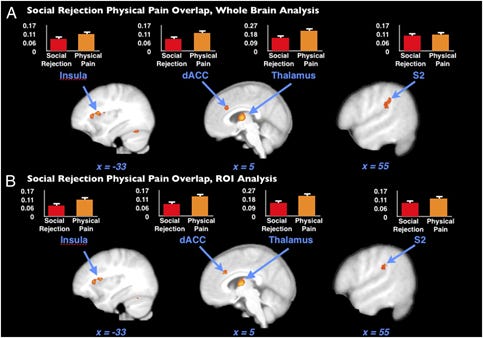
Similar neural pathways of the brain are lighted up in response to both social rejection and physical pain. source: www.pnas.org (1)
For this reason, medieval Europe saw the practice of ostracizing a person as a death sentence. Man, that's ruthless, isn't it? (a trivia about ostracism here)
Moving on, the next question arises. If the fear of height protects you from falling (like falling due to the gravity, not the kind you'd experience when seeing your crush), what does fear of rejection protect us from?
Ultimately, what is it —the part of our self— that is being put to risk when rejected? In a manner in which our brain perceives the pain as similar to that of a physical wound. What is it?
Our expectation? Not quite.
Our social stance? Almost.
Yup, if the word self-worth popped up in your mind, then you've got it right. Next up, try to imagine putting yourself into these situations:
Purposefully throwing a joke but seem to get no laughter at all.
Replying with your best 'hello'' while approaching someone with a blissful feeling only to realize you're not the one who is being greeted with the 'hi'.
And, last but not least, hearing the notorious "let's just be friends" sentence during probably the most emotional times of your adulthood.
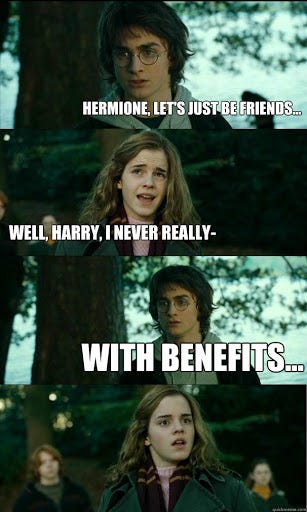
So now, how do you feel? Any better? I hope not.
Well, for one, those situations are just a minuscule of rejection in action. Turns out, we've encountered rejection in its infancy long before we landed an interview with a potential employer. But wait. There's more to rejection than meets the eye.
So, let's back up a little bit.
Just because we're discussing rejection intellectually –thinking our way through the phenomenon–, that doesn't mean we could refrain from treating it as a feeling. Because normally, we feel rejected instead of thinking about rejection.
The feeling of being rejected often translates to an abundance of other feelings, such as being left out when your friends decided to hang out, being ignored(2), getting excluded, and —at the extreme end of the spectrum— getting discriminated. But that's not all. Discrimination in action has another extreme end of the spectrum: ostracizing a person from a group. Like I've mentioned earlier, the feeling is like a death sentence.
(I know I've hit the 1000 words mark, but I still have more memes coming up so don't you dare quit on me now!)
The question isn't whether rejection hurts or doesn't hurt. It's a matter of how much does it hurt? I'm here to offer you a way out enabling you to be less hurt no matter the circumstance you're in. Here's how.
Granted, rejection could only happen in a social sphere. If you're an outlier to the bone —an extreme soloist— chances are there's no one to reject you. But that's not the solution I'm proposing.
Rejection is like a coin with the two sides being the person who rejects and the one who is rejected. When you toss it, either side has to be on the top. The reason we invent the word rejection is that we're damn troubled with the clash between the self-worth you've defined for yourself and the definition demanded by the one who rejects you(3). If the opposing definition triumphs, you're guaranteed to be hurt. Hence, you're rejected and —ultimately— dejected. You are now a reject and that is when a rejection becomes you.
The bigger the clash, the deeper you're going to be hurt.
Is the clash inevitable? Yes, it is. Here's why.
Even though no one cares about you, you like to belong to a particular group of people(4). WE like to belong to a particular group of people and conform to their norms. The way we dress, the way we talk, and –in extreme cases– the way we think are perfectly tuned to the group to gain their acceptance. Once we are out of tune, we are susceptible to social rejection(5). It's the clash between your self-worth defined by you versus the one defined by the group. Yes, you may choose to not conform, but more often than not you don't have the luxury of the choice. Conformity is often automatic, like when you laugh when seeing other people laughing. Here's a hard fact to swallow; conformity is our innate aversion towards rejection. Innate implies the word inevitable.
This way of unclear thinking i.e., the conformity bias(6) is more evident in the internet world when you clicked the video with a million views instead of the one with a thousand views even when content-wise, the latter was more worth-watching. (More about social influence here)
Another reason why we can't evade the clash is that we aren't and never will be self-sufficient. We can't photosynthesis our way out to make a living! Well, maybe, if this guy doesn't exist.
Here's an extra meme for you.
So, that brings us back to square one. Because we're not Groot, we need others to get food.
Fresh grads need jobs. They are easy to be rejected.
Fresh grads who have grand business ideas have to pitch their ideas to venture capitalists. They have to be rejected, most of the time.
Singers, writers, film-makers, comedians, all who have their way in the creative industry(7) are subject to rejection.
More importantly, we need others to feel accepted, to feel like we have a place in this vast world. That's why rejection is scary.
Well, you get my point, the clash is inevitable.
Tons of job applications, massive rejection.
Thousands of information, selective rejection.
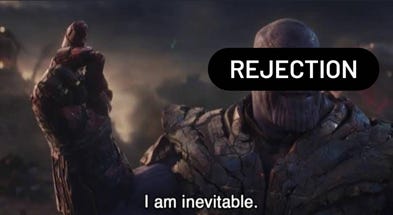
Just like that, the clash is inevitable. Rejection is inevitable.
Have you ever wondered if they actually put up a feature like thumbs down on Instagram(8)?

Like the one they have on YouTube? Guess how many people are still keen on posting on their photos? My bet is none because negativity bias is up and running.

No matter how many likes you've got, a single dislike/reject button could ruin your dopamine ecstasy. But here's the thing, being ignored(9) is enough to feel being rejected. (more on negativity bias here)
Like a veteran psychologist, I've conducted an experiment by issuing a simple 'Yes or no' poll in Instagram stories.
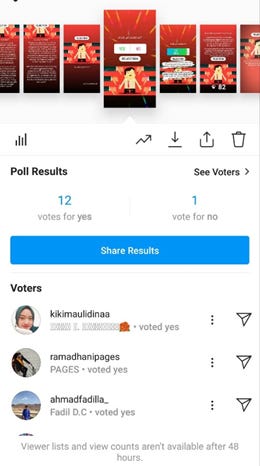
When writing on snap gram, I'm mentally prepared to be ignored because I understand that people only want to see photos and videos instead of lengthy paragraphs. Their attention span is short and that fact is a big deal for them. BUT, when the stakes are VERY LOW, like simply pressing that 'yes' button, I could only translate being ignored as being rejected. 70 accounts viewed my poll and only a dozen responded 'yes'. I am rejected and it hurts even though I've expected to be rejected by some of them. It hurts more when there's an unexpected person who voted big fat 'no'.
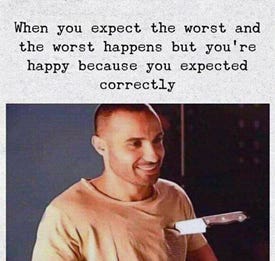
What this experiment has shown me is that expected rejection hurts less, unexpected rejection hurts a lot, and the act of questioning your self-worth to others is the foundation of all rejections.
But, as I promised, here's the way out, a perspective. Instead of asking why me –a major symptom of the protagonist disease–, you could ask: why rejection?
In short, to avoid a circumstance where ''rejection becomes you'', knowing why you are rejected could help. After all, this isn't about you. It's about them who fail to see your greatness. I know it's difficult to make time or provide mental space to consider the people who rejected you as complicated and driven by their need as you are. (more on protagonist disease here)
But once we acknowledge that rejecting isn't a choice of their own volition, we have a fighting chance. You can now try to go into their head and try to empathize with their choice of rejecting you. That way, at the very least, you could say "They have a point. It's now a matter of my own choosing, either to improve to meet their demand or to find others who can make us both feel like we have found each other. And, more importantly, feel like we belong to each other''.
Rejection is sometimes a compass; it marks the places you don't want to go to and forges the option to move on to the next adventure. Our biggest sense of direction comes out of our biggest rejection.
Bottom line? Take every possible rejection head-on but don't ever think of yielding to it. Because yielding to it is when rejection becomes you.
Just like Viktor Frankl once said, "The last human freedom is our ability to get meaning to our circumstances".
One of those circumstances is rejection. Without being rejected(10), I wouldn't have written this piece and let my heart at ease. Thanks for reading the whole thing!
One last trivia: instead of stress eating, it's better to deal with rejection by indulging in movies. You've got 800+ titles of movies about being rejected.
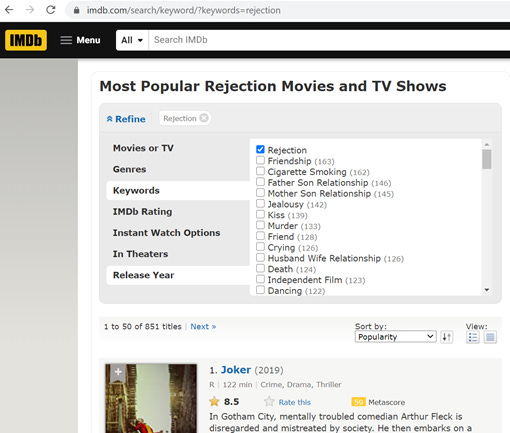
Well, Reddit have a downvote button, does it makes Reddit a superior platform?